
The Sun Can Damage More Than You Think
You probably notice sunlight entering your home every day. What you may not notice is the ultraviolet radiation that comes with it.
Standard window glass filters much of the sun's UVB radiation, but UVA can pass through ordinary glass. The Skin Cancer Foundation specifically identifies windows as a source of indoor UVA exposure. The Skin Cancer Foundation
Over time, sunlight can also contribute to fading and deterioration of hardwood floors, furniture, rugs, artwork and other interior finishes.
For homeowners in Medicine Hat and Southern Alberta, this can be particularly noticeable in rooms with large south- or west-facing windows.
Fortunately, you don't necessarily have to close the blinds and give up your view. Residential window tint can significantly reduce UV radiation passing through your glass while still letting in natural light.
What Are UV Rays?
Ultraviolet radiation is invisible energy produced by the sun. Two types are particularly relevant to homeowners: UVA and UVB.
Ordinary glass does a reasonably good job of filtering most UVB radiation. UVA is different. It can penetrate window glass and reach people and furnishings inside a home. The Skin Cancer Foundation
This is one reason you can see fading on a hardwood floor, sofa or piece of furniture that receives sunlight every day, even though it is indoors.
UV exposure can also affect people. The Skin Cancer Foundation explains that both UVA and UVB can damage skin and increase the risk of skin cancer. The Skin Cancer Foundation
How Does Window Tint Reduce UV Exposure?
Modern residential window films incorporate UV absorbers that reduce the amount of ultraviolet radiation transmitted through the glass.
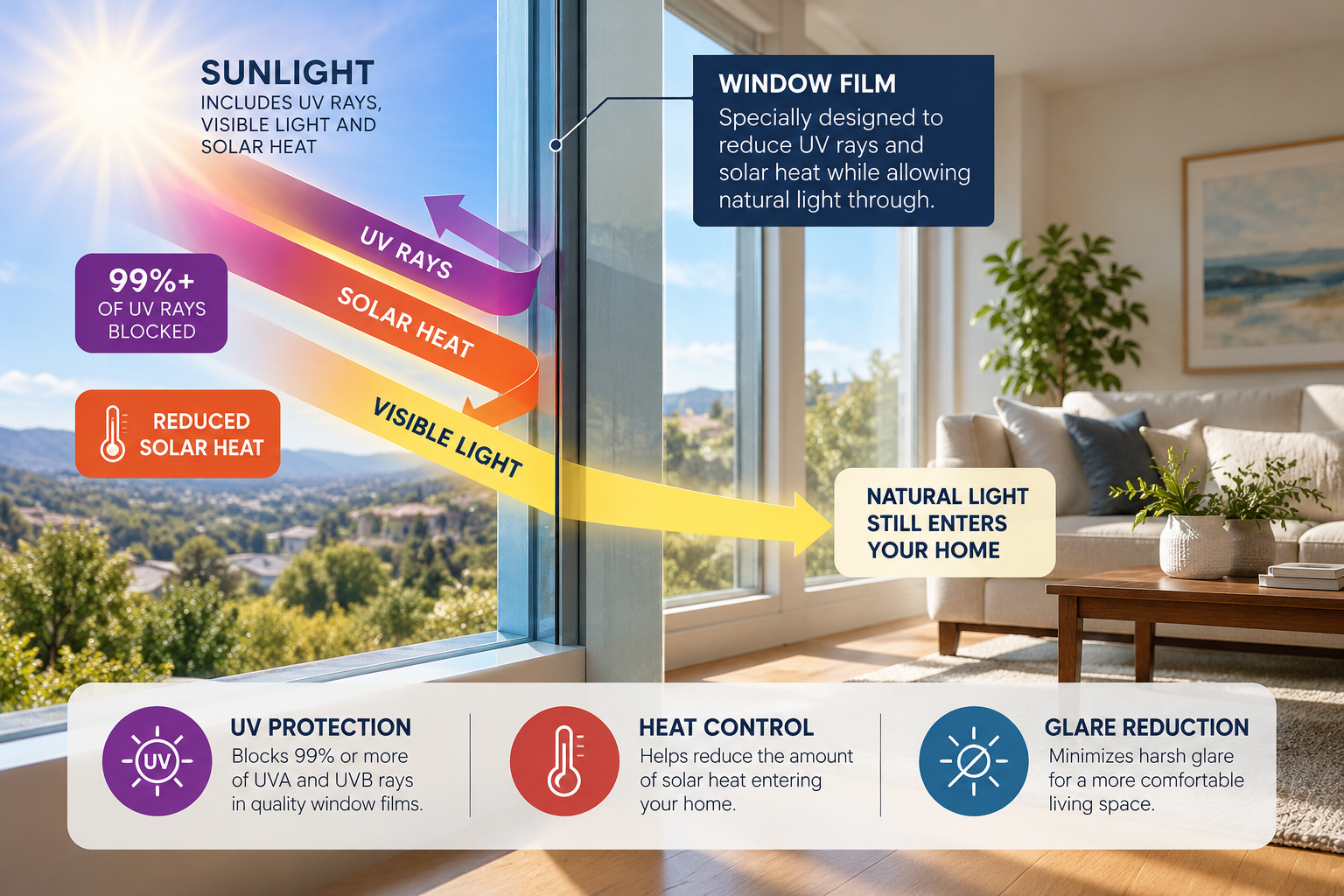
How window film works to balance sunlight coming through your windows
Many high-quality films can block 99% or more of UVA and UVB radiation. In fact, the Skin Cancer Foundation requires a window film or glass product to demonstrate that it blocks at least 99% of UVA and UVB to qualify for its Seal of Recommendation. The Skin Cancer Foundation
One important point is that UV protection does not require extremely dark window tint.
Depending on the product and application, window film can be quite light while still providing substantial UV protection. This can be especially useful in a home where you want to preserve natural light and your view.
If you want to maintain a bright, natural appearance, you may also be interested in our article on spectrally selective window film, which explains how modern film technology can control solar energy without simply darkening the glass.
Can Window Tint Help Protect Hardwood Floors?
Yes, it can help.
Hardwood flooring can gradually change colour when repeatedly exposed to sunlight. The same is true for many laminates, carpets and other flooring materials.
Reducing UV transmission through the windows can remove one important contributor to that deterioration.
But there is an important distinction:
Window tint does not completely stop fading.
It's reasonable to want measurable improvement, but be cautious of vague promises.
A professional should be able to explain what the selected film is designed to accomplish and, where appropriate, provide technical performance information.
Window performance involves several factors, including solar heat gain, visible light transmission, glass type, window orientation, and direct sunlight.
The U.S. Department of Energy explains that the solar heat gain coefficient, or SHGC, measures how much solar heat a window transmits. Lower SHGC values generally indicate less solar heat transmission.
Your installer should be able to explain performance in terms that make sense for your home, rather than simply saying a film is "the best."
For a deeper explanation, see our article on how much heat window tinting actually blocks.
What Else Can Window Tint Help Protect?
UV protection can be valuable for many items in your home, including:
Hardwood and laminate flooring
Carpets and area rugs
Sofas and upholstered furniture
Curtains and fabrics
Artwork and photographs
Wood furniture and cabinetry
Interior finishes and decorative items
The value of that protection can become especially apparent when an expensive floor, sofa or piece of artwork is positioned close to a large window.
The IWFA notes that window film can help reduce fading of furnishings and specifically identifies wood floors, furniture and artwork among the materials affected by sunlight. International Window Film Association
Do I Need Dark Window Tint for UV Protection?
No.
This is one of the biggest misconceptions about residential window tinting.
A dark-looking film and a film's UV performance are not the same thing.
The darkness you see primarily relates to how much visible light passes through the glass. UV radiation is outside the visible portion of the spectrum.
That means a relatively light window film can still provide excellent UV protection.
This is important in residential applications because many homeowners tell me:
"I want to reduce the sun coming through the windows, but I don't want my house to feel dark."
Those two goals don't necessarily conflict.
During a consultation, we can compare different films and discuss UV protection, heat reduction, glare, visible light and appearance separately.
For a closer look at the different options available, see What Type of Window Tint Is Best for My Home in Medicine Hat?
What About Heat and Glare?
UV protection is only one reason homeowners consider window tint.
Depending on the film you choose, residential window tint can also reduce solar heat and glare.
These benefits are related, but you shouldn't confuse them.
For example, a film may provide excellent UV protection without providing the same level of heat rejection as another film designed specifically for solar control.
That's why I don't recommend choosing residential window film based on a single specification.
We look at the entire window, the direction it faces, the type of glass, the amount of sun it receives and what you're trying to accomplish.
If excessive heat is your main concern, read How Much Heat Does Window Tinting Actually Block in Medicine Hat?
Does UV Protection Wear Out?
Quality architectural window films are designed for long-term use, but their lifespan depends on the film, glass, exposure, installation and other conditions.
This is also why product selection matters. The right film must be compatible with the glass it's installed on.
If you're wondering what you can realistically expect from an installation over time, we cover this in much more detail in How Long Does Residential Window Tint Last?
Is UV Protection Worth It If My Furniture Hasn't Faded Yet?
This is actually one of the better times to think about it.
Fading tends to happen gradually. You may not notice a small change from one week to the next.
Sometimes homeowners don't recognize how much colour has changed until they move a rug, picture or piece of furniture and see the original surface underneath.
Window film is therefore better viewed as a preventive measure rather than something that can repair existing damage.
Once flooring, fabrics or artwork have faded, window film cannot restore the lost colour.
It can, however, help reduce future UV exposure.
What About Protecting People From UV?
This benefit is easy to overlook.
According to the Skin Cancer Foundation, UVA radiation can pass through ordinary window glass. It recommends UV-protective window film as one component of a broader sun-protection strategy. The Skin Cancer Foundation
This can be particularly relevant for people who spend significant time beside sunny windows, such as in a favourite chair, kitchen, home office, or living room.
Window film shouldn't be thought of as a replacement for other appropriate sun-protection measures. But reducing UV transmission through the glass can add another layer of protection.
Learn more about UV window film from the Skin Cancer Foundation
Choosing the Right Window Film for UV Protection
If UV protection is your main goal, don't simply choose the darkest film you can find.
There are several questions worth considering:
How much natural light do you want to keep?
Some homeowners want virtually no noticeable change to their windows.
Are heat and glare problems too?
If they are, we can look at films that address multiple concerns at once.
What type of glass do you have?
Film selection should account for the existing glazing system.
Which direction do the windows face?
South- and west-facing windows can present very different conditions from shaded or north-facing glass.
What are you trying to protect?
A homeowner protecting a new hardwood floor may have different priorities than someone trying to make a sunny living room more comfortable.
These are exactly the kinds of questions to discuss before an installation.
For more information, see our 10 Questions to Ask Before Getting Your Home Windows Tinted in Medicine Hat.
Professional Insight From Pinnacle Window Films

“After more than 35 years in the window film industry, I've learned that homeowners often come to us for one problem and discover several connected issues.
A west-facing living room might have fading floors, uncomfortable afternoon heat and television glare at the same time.
Rather than simply choosing a film because it has an impressive UV specification, we look at the whole situation. The glass, exposure, room use and homeowner's priorities all help determine which film makes the most sense.
That approach can deliver better results than simply choosing the darkest film or the product with the biggest number on a spec sheet.”
Jack Klassen
Partner - Pinnacle Window Films
Final Thoughts
Residential window tint can effectively reduce UV exposure inside your home and help protect flooring, furniture, artwork, and other interior finishes.
High-quality window films block 99% or more of UVA and UVB radiation, and strong UV protection doesn't necessarily mean your home will look noticeably darker. The Skin Cancer Foundation
Just remember that UV is not the only cause of fading. Visible light, heat and the materials themselves also play a role. Window film can reduce fading, but no responsible installer should promise that it will completely prevent it. International Window Film Association
The best solution balances UV protection with your other priorities, including heat control, glare, natural light, and appearance.
Ready to Learn What Will Work for Your Home?
Call Pinnacle Window Films at 403-472-9352 or visit us at 913 S Railway St, Medicine Hat, AB.
You can also book a free consultation online at pinnaclewindowfilms.ca and start taking control of your home’s comfort today! Our free consultations will help you understand just how well our films perform, so you know exactly what to expect.
Frequently Asked Questions
Does residential window tint block UV rays?
Yes. Many quality residential window films can block 99% or more of UVA and UVB radiation. The exact performance depends on the film selected. The Skin Cancer Foundation
Will window tint completely stop my furniture and floors from fading?
No. Window film can significantly reduce UV exposure, but UV isn't the only cause of fading. Visible light, heat, and the materials themselves can also contribute. International Window Film Association
Do I need dark window tint to get UV protection?
No. Films with strong UV protection are available and still allow substantial visible light through the glass. Evaluate darkness and UV protection separately.
Can UVA rays pass through house windows?
Yes. Ordinary window glass filters most UVB, but UVA can pass through glass. The Skin Cancer Foundation
Can window tint protect hardwood floors?
It can help. By substantially reducing UV transmission, window film removes one important contributor to fading. It cannot completely prevent colour changes because UV isn't the only factor involved.
