
10 Questions to Ask Before Getting Your Home Windows Tinted in Medicine Hat
If you're considering window tinting for your home, you've probably already identified a problem.
Maybe one room gets unbearably hot in the afternoon. Perhaps glare makes your television or computer difficult to see. Maybe you're concerned about UV exposure and fading, or you want more privacy without closing your blinds all day.
Once you've decided that window film may be worth exploring, the next question is:
How do you know you're choosing the right film and the right installer?
Not all window film is designed for the same purpose, and not every window is the same. The right solution depends on your glass, your home's exposure, your goals, and the performance you expect from the installation.
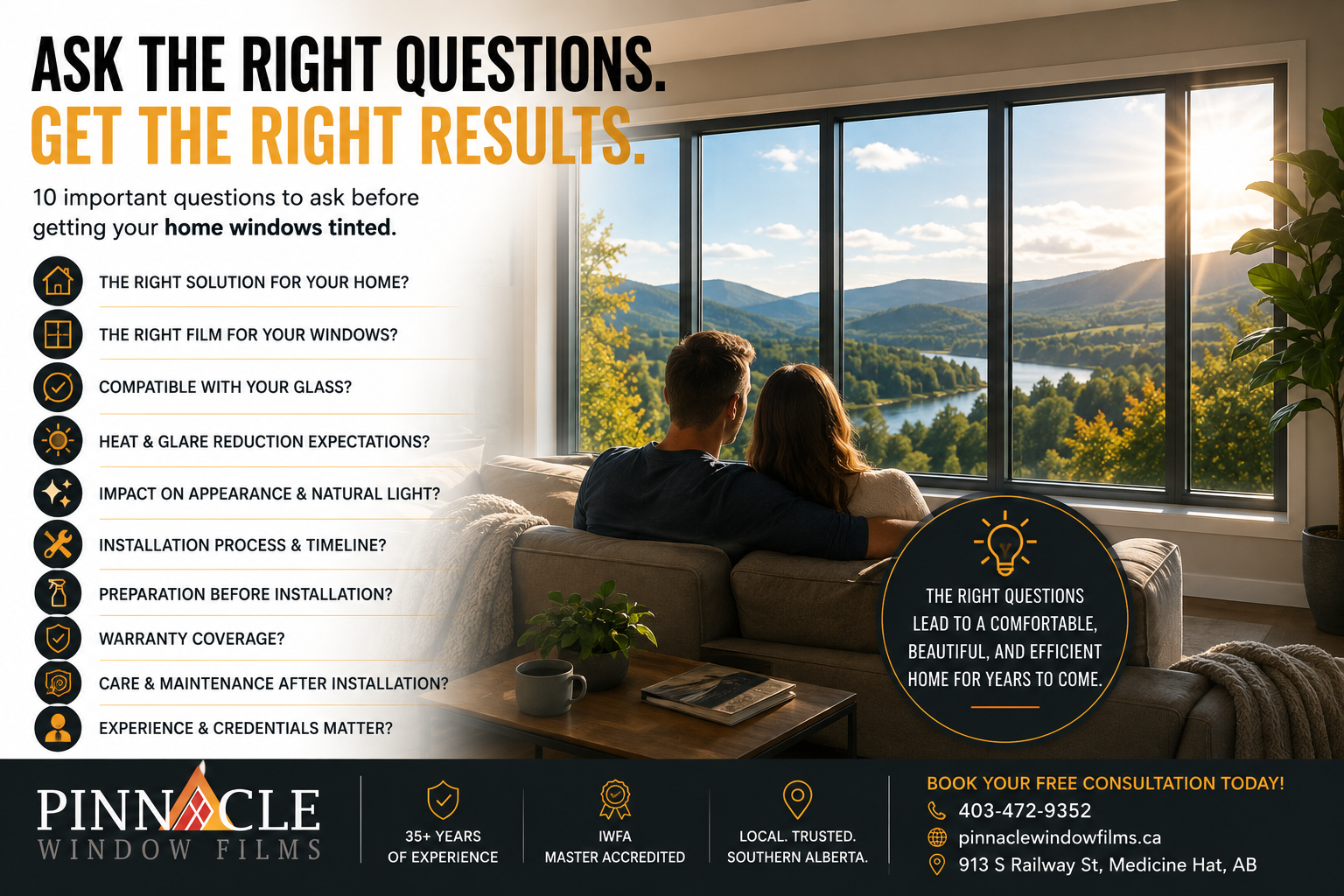
Before getting your windows tinted, here are 10 questions worth asking.
1. What problem am I actually trying to solve?
This may sound obvious, but it is one of the most important questions to answer before choosing a film.
Are you primarily looking for:
Reduced solar heat?
Less glare?
Better privacy?
UV protection?
Protection for furniture and flooring?
A more comfortable home office?
A better environment for watching television?
Improved appearance?
You may have several goals, but identifying your priorities helps determine what type of film makes sense.
For example, a homeowner primarily concerned about afternoon heat may need a very different solution from someone whose main concern is bathroom privacy.
Before comparing films, start by identifying the problem.
2. What type of window film is best for my windows?
No single window film is automatically the best choice for every home.
Different film technologies can provide different combinations of:
Solar heat rejection
Visible light transmission
Glare reduction
UV protection
Privacy
Appearance
Your windows themselves also matter.
The type of glass, existing coatings, construction, orientation, and sunlight exposure can all affect which film is appropriate.
If you're still trying to understand the differences between film technologies, our guide to what type of window tint is best for your home in Medicine Hat goes into more detail.
And if maintaining natural light while controlling solar heat is particularly important to you, our article on spectrally selective window film is worth reading.
3. Is my existing glass compatible with window film?
This is a question homeowners should absolutely ask before installation.
Modern homes can contain many different types of glass and glazing systems, including insulated glass units and glass with low-emissivity coatings.
Window film isn't simply a matter of applying the same product to every pane of glass.
The International Window Film Association specifically notes that whether film is appropriate for Low-E glass depends on factors including the type and location of the Low-E surface, as well as the desired performance. The organization recommends discussing compatibility with a qualified dealer.
A knowledgeable installer should be able to identify the glass and determine whether the proposed film suits the application.
That assessment matters most with specialty glass, insulated units, or existing coatings.
4. How much heat and glare should I realistically expect to reduce?
It's reasonable to want measurable improvement, but be cautious of vague promises.
A professional should be able to explain what the selected film is designed to accomplish and, where appropriate, provide technical performance information.
Window performance involves several factors, including solar heat gain, visible light transmission, glass type, window orientation, and direct sunlight.
The U.S. Department of Energy explains that the solar heat gain coefficient, or SHGC, measures how much solar heat is transmitted through a window. Lower SHGC values generally indicate less solar heat transmission.
Your installer should be able to explain performance in terms that make sense for your home, rather than simply saying a film is "the best."
For a deeper explanation, see our article on how much heat window tinting actually blocks.
5. Will the film make my home look noticeably darker?
This is one of the most common homeowner concerns.
The answer depends on the film selected.
Window film can vary considerably in visible light transmission and appearance. Some films provide strong solar control while maintaining a relatively light appearance.
This is one reason it is important not to choose a film based solely on how dark it looks.
If maintaining a bright interior is important to you, tell your installer.
The goal is to find an appropriate balance between performance and appearance.
6. How will the installation be performed?
Don't hesitate to ask what the installation process actually involves.
A professional installation should include proper glass preparation and careful film application.
Ask:
How will the glass be prepared?
How will the film be cut?
What happens around the edges?
How long will installation take?
What should I expect immediately after installation?
How long will the film take to cure?
The installation process can vary depending on the glass type and application. The International Window Film Association provides consumer information covering what to expect before, during, and after a professional window film installation.
Understanding the process beforehand can also help you recognize the difference between professional workmanship and a rushed installation.
If you're considering installing film yourself, our guide to DIY vs. professional window tinting covers some factors worth considering.
7. What warranty comes with the film and installation?
A window film warranty is an important part of the purchasing decision.
Ask exactly what is covered and who provides the warranty.
Questions worth asking include:
How long is the warranty?
Does it cover the film, the installation, or both?
What types of problems are covered?
Are there exclusions?
Who handles warranty claims?
Don't assume that every film installation has identical warranty coverage.
A reputable installer should be comfortable explaining the warranty before you decide.
This is also an area where comparing quotes strictly by price can be misleading. Two installations may have very different materials, workmanship, and warranty coverage.
8. How should I care for the windows after installation?
Window film doesn't require complicated maintenance, but you should know what is recommended after installation.
Ask your installer:
When can the windows be cleaned?
What cleaning products are appropriate?
Can I use a squeegee?
Are there any products or tools I should avoid?
The International Window Film Association recommends using a soft, clean cloth, soft paper towel, or clean synthetic sponge with a normal glass-cleaning solution that does not contain abrasive materials.
Your installer should also provide any specific care instructions appropriate for the film being installed.
9. How long should the window film last?
Longevity is an important part of determining whether an installation represents good value.
The answer isn't necessarily a single number.
According to the International Window Film Association, the effective life of window film can vary based on factors including film type, glass type, window construction, compass orientation, and geographic location. Quality residential and commercial films are warranted by their manufacturers.
That means a good installer shouldn't simply give you an arbitrary lifespan without considering the application.
For more information, read our guide to how long residential window tint lasts.
10. What experience and credentials does the installer have?
Finally, ask about the person or company actually installing the film.
A window film installation may look simple from the outside. Still, proper product selection and installation require knowledge of film technology, glass, application techniques, and the conditions affecting long-term performance.
Ask about:
Industry experience
Professional training
Certifications
Accreditation
Manufacturer training
Warranty support
Previous residential installations
You can also ask how long the company has been installing window film and whether they specialize in window film or offer it as one of many unrelated services.
If you're comparing installers in Southern Alberta, our guide on how to find a reliable window tinting company in Medicine Hat provides additional questions to consider.
From the Installer's Perspective

“After more than 35 years in the window film industry, we've learned that the most important part of a successful installation often happens before the film ever touches the glass.
Every home is different.
The right solution for a large west-facing living room may not be the right solution for a bedroom, bathroom, or home office. Glass type, sun exposure, the homeowner's priorities, and the desired appearance all need to be considered together.
That's why we believe a good window film consultation should be about more than simply choosing a shade or comparing a price per square foot.
The goal is to understand the problem first, evaluate the application, and then recommend a solution that makes sense for the home.”
Jack Klassen
Partner - Pinnacle Window Films
Don't Choose Window Film Based on Price Alone
Getting multiple quotes can be useful, but comparing window film installations solely by price can leave out some important details.
When comparing quotes, consider:
What film technology is being proposed?
What are its performance characteristics?
Is it appropriate for your glass?
Who will perform the installation?
What experience does the installer have?
What warranty is included?
What preparation and cleanup are included?
Will the installer explain what to expect after installation?
The least expensive quote isn't necessarily the least expensive solution over the long term.
Likewise, the most expensive film isn't automatically the best choice.
The better question is:
Does the proposed solution match my home's windows and the problem I'm trying to solve?
A Good Consultation Should Answer Your Questions
You shouldn't feel pressured to understand every technical specification before contacting an installer.
A professional consultation should help you understand:
What is causing the problem?
Which film options are appropriate?
What performance can reasonably be expected?
How will the film affect the appearance of the glass?
How will the installation be performed?
What warranty applies?
How should the finished installation be maintained?
The more clearly these questions are answered, the easier it becomes to make an informed decision.
Final Thoughts
Residential window tinting can be a valuable improvement for homeowners dealing with excessive heat, glare, UV exposure, privacy concerns, or uncomfortable rooms.
But choosing the right film is only part of the equation.
The quality of the glass, the film technology, the installation, and the installer's experience all matter.
Before signing a contract, take the time to ask questions and make sure you understand what you're buying.
A good window film installer should welcome those questions.
Call Pinnacle Window Films
Call Pinnacle Window Films at 403-472-9352 or visit us at 913 S Railway St, Medicine Hat, AB.
You can also book a free consultation online at pinnaclewindowfilms.ca and start taking control of your home’s comfort today! Our free consultations will help you understand just how well our films perform, so you know exactly what to expect.
Frequently Asked Questions
What should I ask before getting residential window tint?
Ask about the type of film recommended, glass compatibility, expected heat and glare reduction, appearance, installation process, warranty, maintenance, lifespan, and the installer's experience and credentials.
Is every type of window glass compatible with window film?
No. Compatibility depends on factors such as glass construction, coatings, and the particular film being considered. A qualified installer should evaluate the glass before recommending a film.
Should I get multiple quotes for residential window tinting?
Comparing quotes can be useful, but don't compare price alone. Look at the proposed film, performance, installation process, warranty, experience, and whether the product is appropriate for your windows.
How long does residential window tint installation take?
Installation time varies according to the number and size of windows, the type of glass, accessibility, and the complexity of the project. Your installer should be able to provide a project-specific estimate.
Is professional window film installation worth it?
Professional installation can help ensure proper glass preparation, film application, product selection, and compatibility. The quality of installation can also affect the appearance and long-term performance of the finished project.
