
Can Window Film Be Applied to Any Type of Glass?
A Guide for Medicine Hat Homeowners
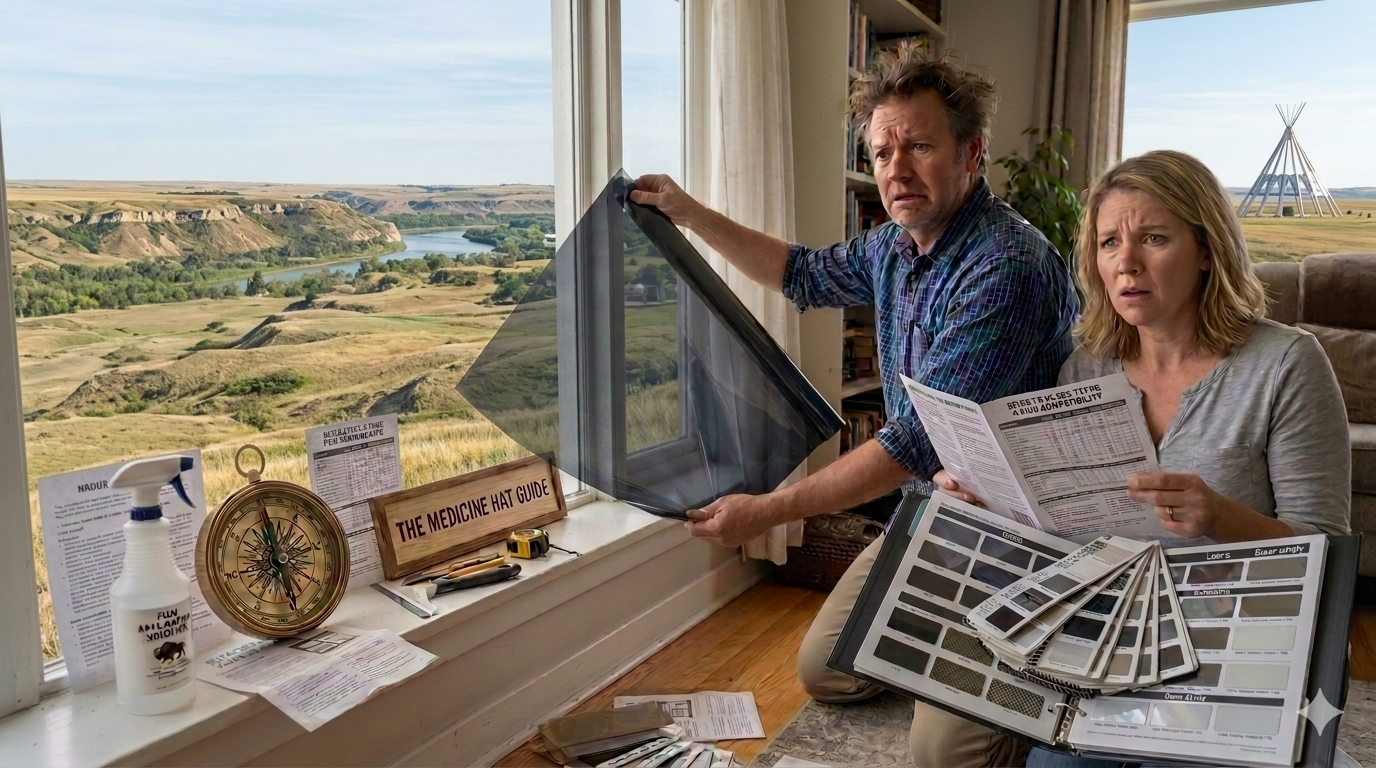
If you're considering residential window tinting, you may assume the process is straightforward: choose a film, apply it to the glass, and enjoy a cooler, more comfortable home.
In reality, the glass matters as much as the film.
Modern homes can contain several different types of glass and glazing systems. Some windows are single pane. Others are double- or triple-pane insulated glass units. Some incorporate Low-E coatings, while others may use tempered or laminated glass.
That doesn't mean you can’t install window film on these types of glass.
It means the film needs to be selected for the particular glass and application.
This is one of the reasons a professional assessment is so important.
The International Window Film Association explains that film-to-glass compatibility depends on factors such as glass type, thickness, glazing construction, coatings, orientation and other characteristics of the installation.
So, can window film be installed on any type of glass?
Not automatically. But many different types of residential glass can be suitable for window film when the correct product is selected and properly installed.
Let's look at what homeowners should know.
Why Does the Type of Glass Matter?
Window glass isn't simply a transparent surface.
It interacts with sunlight and heat in different ways depending on how it is constructed.
When solar radiation reaches a window, some energy is transmitted through the glass, some is reflected, and some is absorbed by the glass itself.
Adding window film changes that balance.
The amount of solar energy absorbed by the glass can be an important consideration when evaluating a film installation.
The IWFA notes that thermal stress is one of the factors that window film manufacturers consider when determining appropriate film-to-glass combinations. Manufacturers provide compatibility information for different film and glass configurations.
That's why an experienced installer doesn't simply recommend the same film for every window in a house.
What About Single-Pane Glass?
Single-pane glass is relatively straightforward compared with some modern glazing systems.
It consists of one piece of glass rather than an insulated unit containing multiple panes.
Depending on the glass characteristics, size, orientation and film selected, many single-pane windows can be suitable candidates for window film.
However, "single pane" by itself doesn't tell an installer everything they need to know.
Glass thickness, dimensions, exposure and the film's performance characteristics can all matter.
This is particularly important with large areas of glass, where the consequences of an inappropriate film-to-glass combination can be greater.
Can Window Film Be Installed on Double-Pane Windows?
Often, yes.
Double-pane windows, also called insulated glass units or IGUs, contain two panes of glass separated by a spacer and sealed around the perimeter.
The space between the panes is designed to improve insulation and reduce heat transfer.
The U.S. Department of Energy explains that insulated glazing can improve thermal performance by reducing heat transfer. At the same time, Low-E coatings can further influence both heat transfer and solar heat gain.
However, double-pane construction introduces additional considerations for window film.
The film may change how the glass absorbs solar energy, and the interaction between the film, glass, coatings and surrounding conditions needs to be evaluated.
The IWFA specifically notes that insulated glazing units require special consideration when selecting window film because they can be more susceptible to thermal stress under certain combinations of glass and film.
That doesn't mean:
"Never put film on double-pane windows."
It means:
“Don't assume every film is appropriate for every double-pane window.”
That's a very important distinction.
What About Triple-Pane Windows?
Triple-pane windows contain three panes of glass and two insulating spaces.
They're designed to provide excellent thermal performance and are increasingly common in energy-efficient construction.
As with double-pane windows, film selection should consider the complete glazing system rather than simply the number of panes.
The International Window Film Association's technical guidance identifies glazing type, glass thickness, coatings, orientation, climate and other factors as part of the film-to-glass compatibility assessment.
A professional installer should therefore identify the construction of the window before recommending a film.
Can Window Film Be Installed on Low-E Glass?
This is one of the most important questions homeowners should ask.
Sometimes, yes. But it depends on the Low-E system.
Low-E means low emissivity.
Low-E coatings are extremely thin coatings applied to glass to control radiant heat transfer. The U.S. Department of Energy explains that Low-E coatings can influence both the thermal performance and solar heat gain characteristics of a window.
The important detail is that Low-E isn't one single type of glass.
The coating can be located on different surfaces within an insulated glazing unit.
The International Window Film Association states that whether window film should be used on Low-E glass depends on:
The type of Low-E surface
The location of that surface
The desired amount of heat gain reduction
The desired heat-loss reduction
Other film benefits being sought
The IWFA recommends asking a qualified dealer whether a particular Low-E window is suitable for film.
This is a perfect example of why a simple "yes" or "no" answer isn't enough.
What Is the Difference Between Low-E Glass and Window Film?
This is another point that can cause confusion.
Low-E is a coating integrated into the glass or glazing system.
Window film is a separate material applied to the glass surface.
They can both influence the way heat and solar energy interact with a window, but they aren't interchangeable technologies.
The U.S. Department of Energy describes Low-E coatings as microscopically thin coatings applied directly to glass surfaces. Window films are retrofit products that are applied to existing windows.
This distinction becomes particularly important when evaluating an existing home's windows.
A homeowner may already have relatively sophisticated glazing and still benefit from additional solar-control measures, but the appropriate solution depends on the existing window and the desired result.
What About Tempered Glass?
Tempered glass is heat-treated to increase its strength compared with ordinary annealed glass.
It's commonly used in locations where safety glazing is required or desirable, such as certain doors and other applications.
Tempered glass has different breakage characteristics from ordinary glass, but that doesn't mean you can ignore the film selection.
The IWFA's current technical guidance distinguishes among different glass types and notes that film selection needs to account for glass construction and thermal considerations.
In other words:
Tempered does not automatically mean "any film is fine."
The film still needs to be appropriate for the application.
Can Window Film Be Installed on Laminated Glass?
Laminated glass consists of layers of glass bonded around an interlayer.
It's commonly used where additional safety, sound-control or other performance characteristics are desired.
Because laminated glass has a different construction from monolithic or insulated glass, it needs to be evaluated accordingly.
The IWFA identifies laminated glass as a distinct glazing construction and provides technical guidance for evaluating different glass and film combinations.
Again, the important takeaway isn't that laminated glass is automatically unsuitable.
It's that glass construction needs to be identified before selecting the film.
What About Large Windows?
Large panes deserve additional attention.
A large piece of glass can behave differently from a smaller pane because of its dimensions, thickness, framing and exposure.
The IWFA's 2026 technical guidance specifically cautions that large panes require careful consideration because glass thickness, size and the relationship between the glass area and its edge support can affect stress.
This is one of the situations where professional evaluation is particularly valuable.
If your home has large picture windows, extensive floor-to-ceiling glazing or unusual architectural glass, don't choose a film based solely on its advertised heat-rejection number.
The glass and film need to be considered as a system.
What About Skylights?
Skylights are another special situation.
They receive direct solar exposure from above and can have different installation and environmental considerations than vertical windows.
The IWFA's current technical guidance notes that skylights can be more restricted applications and recommends consulting the film manufacturer for specific installation instructions and requirements.
If you're considering film for a skylight, make sure the installer specifically evaluates that application rather than treating it like an ordinary vertical window.
Why Does Window Orientation Matter?
The direction a window faces can affect the amount and timing of solar exposure.
East-facing windows receive morning sun.
West-facing windows can receive intense afternoon sun, which can be particularly noticeable during hot summer conditions.
South-facing windows can receive substantial solar exposure, while north-facing windows generally receive less direct solar radiation in many situations.
The U.S. Department of Energy notes that east- and west-facing windows can present particular challenges for controlling heat and glare because of the angle of the sun.
For a homeowner in Medicine Hat, this matters because the same film may not necessarily be the best solution for every window in the house.
Why the Right Film Matters
One of the biggest misconceptions about window tinting is that choosing a darker film automatically solves a heat problem.
Modern window film technology is much more sophisticated than that.
Films can be engineered with different combinations of visible light transmission, solar energy performance, reflectivity, absorption and other characteristics.
The IWFA explains that today's films can manage different portions of solar energy through multiple layers and coatings, and that visible appearance does not necessarily tell you how effectively a film controls solar energy.
That's particularly relevant to the spectrally selective film we discussed previously.
The objective isn't necessarily to make your windows darker.
It's to manage the unwanted portions of solar energy while maintaining the characteristics you value, such as natural light and clear views.
From the Installer's Perspective
“After more than 35 years in the window film industry, one of the most important lessons we've learned is that there is no such thing as a one-film-fits-all solution.
When we look at a home, we're not just looking at the windows as pieces of glass.

We're considering:
What type of glass is installed
How the windows are constructed
Whether coatings are present
Which direction the windows face
How much direct sunlight they receive
The size of the glass
What the homeowner wants to accomplish
How the finished installation should look
Two windows that look identical from inside the room can have very different specifications.
That's why we believe the right place to start is with the glass and the homeowner's goals, not with a particular film product.”
Jack Klassen
Partner - Pinnacle Window Films
How a Professional Window Film Assessment Works
A professional assessment doesn't have to be complicated.
The installer should begin by understanding what you're trying to accomplish.
Then they can evaluate the windows and consider factors such as:
1. Glass type
Is it single-pane, insulated, laminated, tempered, or another configuration?
2. Existing coatings
Does the glass already have a Low-E or other coating?
3. Orientation
Which direction does the window face?
4. Exposure
How much direct sunlight does it receive?
5. Film performance
What solar-control characteristics does the proposed film have?
6. Appearance
How much visible light do you want to maintain?
7. Application conditions
Are there unusual factors such as large panes, skylights or uneven shading?
This process helps narrow the available options to films that make sense for the specific application.
Should You Ask Your Installer for Film-to-Glass Compatibility Information?
Absolutely.
This is one of the best questions you can ask.
A reputable installer should be able to explain why the proposed film is appropriate for your glass.
The IWFA states that manufacturers provide recommended film-to-glass information and that consumers who have concerns should request the applicable guidelines.
You don't need to become a glazing engineer.
You simply need to know that the installer has considered compatibility rather than selecting a film based solely on appearance or a single performance number.
The Bottom Line
So, can window film be applied to any type of glass?
No single film should be assumed to be appropriate for every type of glass.
But many residential glass types can be successfully treated when the film is properly selected for the application.
Single-pane, double-pane, triple-pane, Low-E, tempered and laminated glass can all involve different considerations.
The important question isn't simply:
"Can I put window film on this glass?"
It's:
"Which film, if any, is appropriate for this glass and what I'm trying to accomplish?"
That's the question a professional assessment should answer.
Call Pinnacle Window Films
Call Pinnacle Window Films at 403-472-9352 or visit us at 913 S Railway St, Medicine Hat, AB.
You can also book a free consultation at pinnaclewindowfilms.ca to get clear recommendations for your home. We’ll walk you through film options and performance so you know exactly what to expect before making a decision.
Frequently Asked Questions
Can window film be installed on double-pane windows?
Many double-pane windows can be suitable for window film, but the glass construction and proposed film need to be evaluated for compatibility before installation.
Can window film be installed on Low-E glass?
It can be appropriate for some Low-E windows, but compatibility depends on the type and location of the Low-E coating and the performance characteristics of the proposed film. A qualified installer should evaluate the window before recommending a film.
Can window film be installed on tempered glass?
Tempered glass can require different considerations from other glass types. The appropriate film should be selected based on the complete glass and window configuration rather than simply assuming compatibility.
Can window film be installed on triple-pane windows?
Some triple-pane windows can be treated with window film, but the glazing construction, coatings, glass characteristics and film specifications should be evaluated before installation.
Does darker window film always reject more heat?
No. Film appearance alone doesn't determine solar-control performance. Modern films can be designed to manage solar energy while maintaining relatively high visible light transmission.
