
Does Home Window Tint Provide Privacy During the Day and at Night?
A Homeowner’s Guide for Medicine Hat
Privacy is one of the most common reasons homeowners consider residential window tinting.
Maybe your living room faces a busy street. Perhaps your neighbours have a clear view into your kitchen. Or you want to enjoy your home without keeping the blinds closed all day.
Window film can help improve privacy, but there’s something important to understand before choosing a product:
Not all privacy window films work the same way, especially after dark.
Some films provide daytime privacy while preserving your view outside. Others provide privacy both day and night but limit your ability to see through the glass.
Understanding these differences can help you choose a film that meets your expectations.
How Does Residential Privacy Window Film Work?
Privacy window films generally fall into three categories: reflective, frosted and opaque films.
Each provides a different level of privacy and visibility.
Reflective window film
Reflective films create a mirrored appearance under certain lighting conditions.
During the day, when it’s brighter outside than inside, the glass can appear reflective to someone looking in. Meanwhile, people inside can often continue enjoying their view outdoors.
This makes reflective film popular for living rooms, street-facing windows and other areas where homeowners want daytime privacy without completely blocking their view.
However, reflective film has an important limitation: its privacy effect depends on the lighting conditions.
Frosted window film
Frosted films create a translucent appearance that allows light through while obscuring a clear view.
Unlike reflective film, frosted film doesn’t rely on brighter outdoor lighting to provide privacy.
It’s commonly used for bathrooms, entry doors, sidelights, and other windows where privacy is important day and night.
Opaque window film
Opaque films block the view through the glass.
They’re useful when maximum visual privacy is more important than maintaining a view or allowing natural light.
For homeowners who want privacy without completely blocking daylight, frosted or translucent decorative films may be more suitable.
Does Reflective Window Tint Provide Daytime Privacy?
Yes, reflective window film can provide effective daytime privacy when lighting conditions are favourable.
Here’s why.
During daylight hours, the outside of your home is often much brighter than the interior.
A reflective film can make the glass's exterior surface appear mirror-like, making it harder for someone outside to see into the room.
At the same time, homeowners can often see outdoors through the film.
This is sometimes called the one-way mirror effect.
But it isn’t truly one-way glass.
The effect depends on the brightness difference between the two sides of the window.
For example, a living room with large windows facing a sunny street may benefit from reflective film during the day.
However, if the room is brightly illuminated while the exterior is shaded, the privacy effect may be weaker.
The amount of privacy also depends on the film’s reflectivity, visible light transmission, window conditions and viewing angle.
That’s why it’s important to evaluate the actual windows rather than assume every reflective film will provide the same result.
For more information about choosing films for different residential applications, read our article, What Type of Window Tint Is Best for My Home in Medicine Hat?
Does Window Tint Provide Privacy at Night?
This is probably the most important question in this article, because the answer changes after dark.
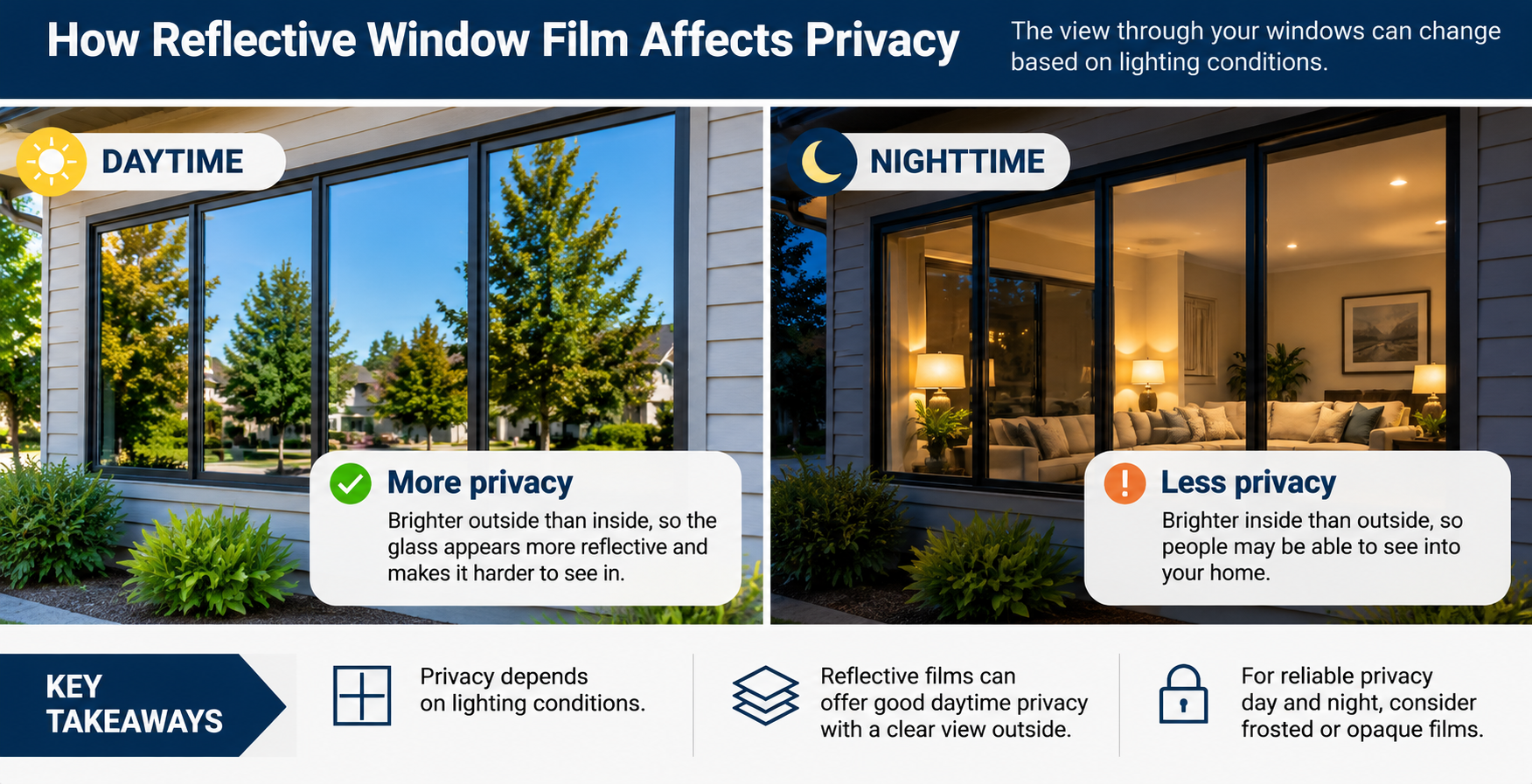
Most conventional reflective window films do not provide reliable nighttime privacy when the lights are on inside your home.
During the day, outdoor sunlight creates the brightness difference that helps reflective film provide privacy.
At night, those conditions often reverse.
Your home may be brightly lit while the exterior is dark.
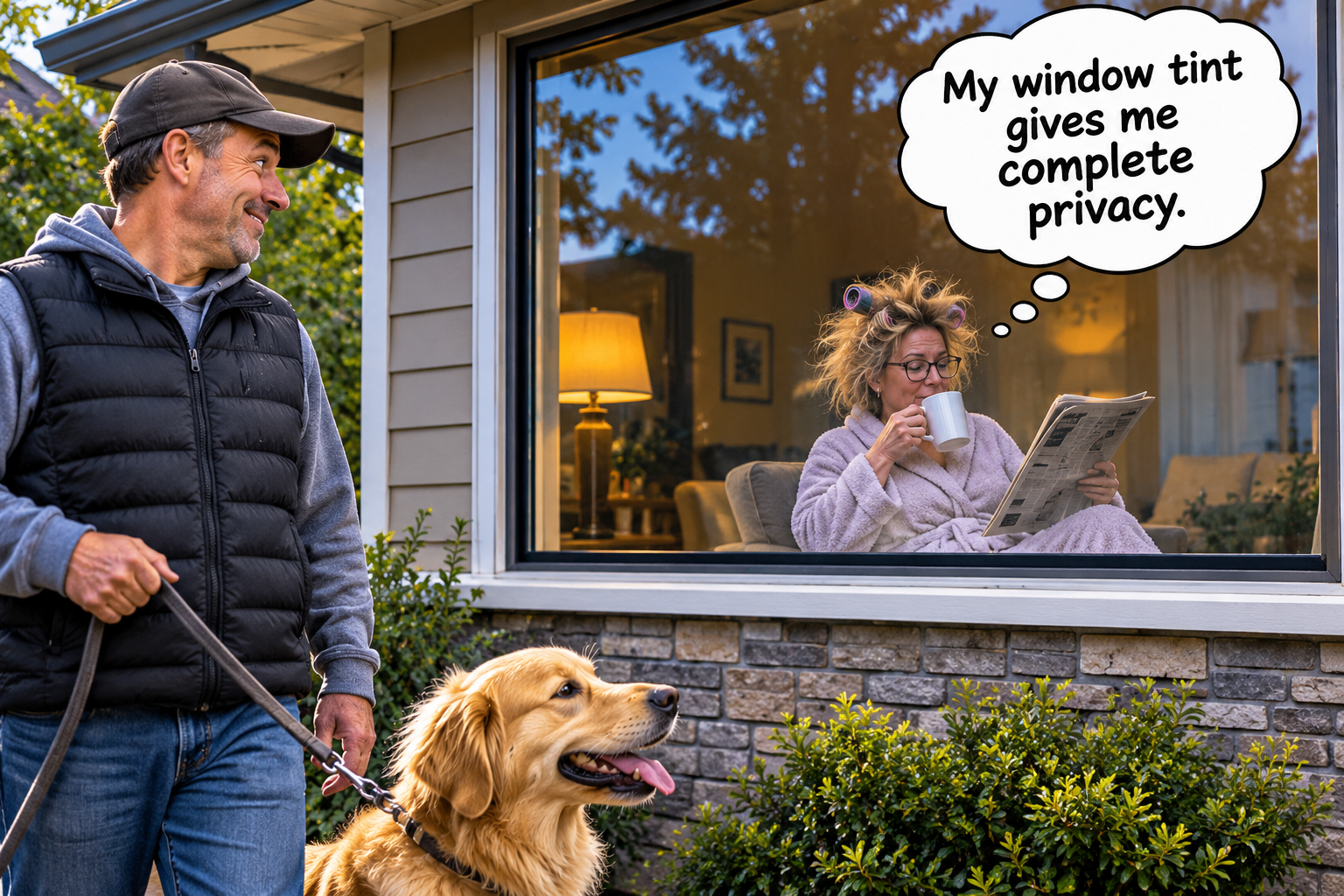
As a result, someone standing outside may be able to see through the glass more easily, while the homeowner sees reflections of the room.
The film hasn’t stopped working. The lighting conditions have changed.
This is why reflective window film shouldn’t be sold as a guaranteed solution for nighttime privacy.
If you’re considering reflective film for a bedroom, bathroom, or another space where privacy after dark is essential, you need to discuss this limitation before installation.
Curtains, blinds, shutters or a different type of privacy film may be necessary.
What Does Alberta’s Permanent Daylight Saving Time Mean for Window Privacy?
Alberta made an important change to its time system in 2026.
Beginning November 1, 2026, the province stopped changing its clocks twice a year and adopted permanent Alberta Time, or ABT.
This means Alberta now remains on UTC−6 year-round.
Under the previous system, clocks moved back one hour in the fall. Under the new system, winter sunsets occur approximately one hour later on the clock than they would have under the former standard-time arrangement.
According to the Government of Alberta, the change eliminates seasonal clock adjustments and establishes a consistent time throughout the year.
But what does this mean for window privacy?
The important thing to remember is that changing the clocks doesn’t change how reflective window film works.
Privacy still depends on the lighting conditions inside and outside your home.
As daylight fades and interior lights become brighter than the outdoors, the daytime privacy effect of reflective film can weaken.
Even with Alberta’s new time system, homeowners who need nighttime privacy should consider solutions that don’t depend on outdoor brightness.
For additional information about the province’s change, visit the Government of Alberta’s official explanation of Alberta Time.
Can One-Way Mirror Window Film Provide Privacy at Night?
You’ve probably seen advertisements for products described as one-way mirror window film.
The name can make it sound as though you can always see outside while nobody can see inside.
Unfortunately, that’s not how conventional reflective window film works.
Reflection and differences in lighting create the mirrored appearance.
When the outside is brighter, the film can provide daytime privacy.
When the inside is brighter, the effect can reverse.
Some specialized products and lighting arrangements may offer different results, but homeowners shouldn’t assume that a standard reflective film will provide one-way visibility under all conditions.
If a product is advertised as providing nighttime privacy while maintaining a clear outward view, ask the supplier to demonstrate its performance under realistic nighttime lighting.
Which Window Film Provides Privacy Both Day and Night?
For dependable visual privacy regardless of whether it’s sunny or dark outside, frosted and opaque films are generally more appropriate than conventional reflective films.
Here’s a simple comparison.
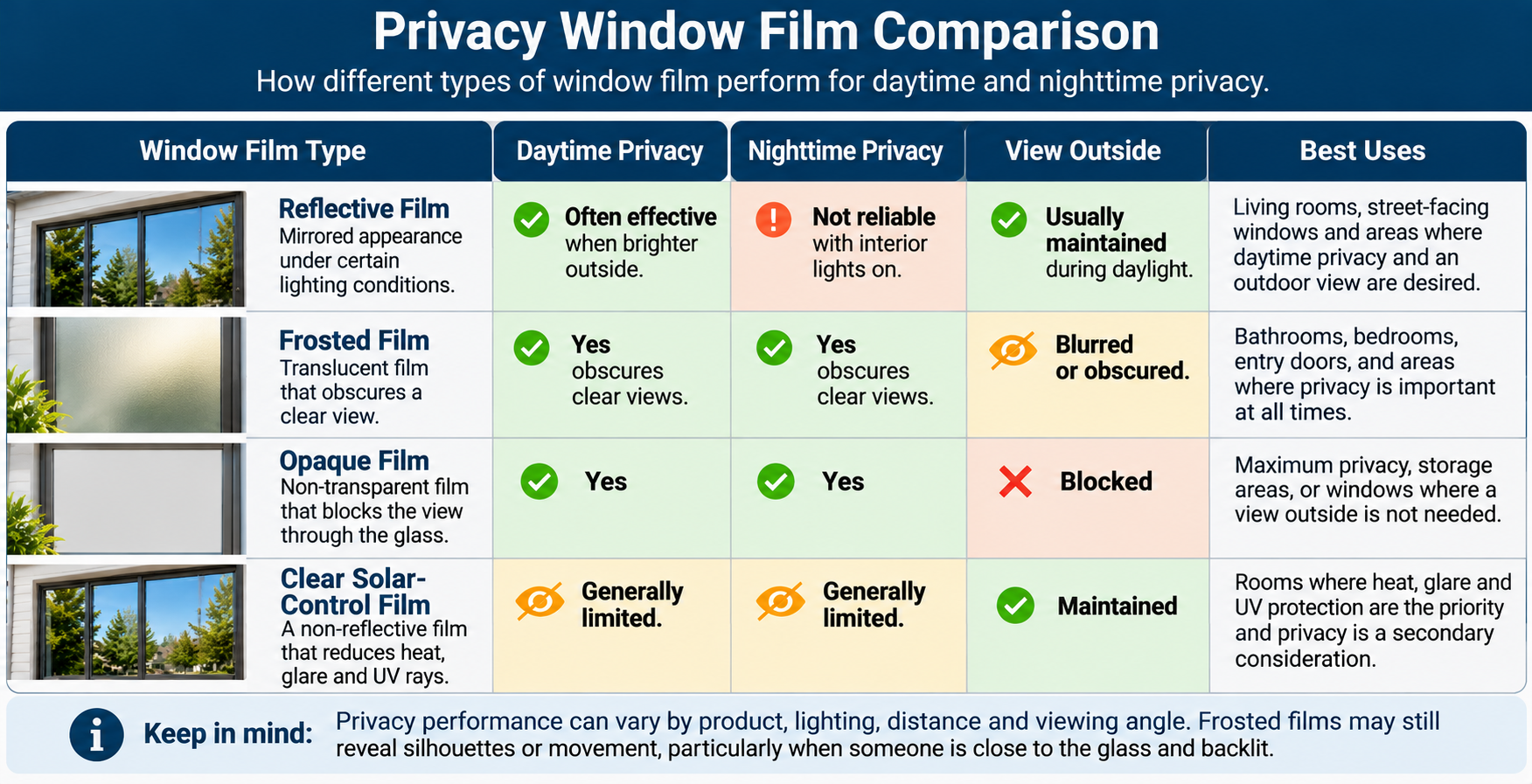
The right choice depends on what you’re trying to accomplish.
A homeowner who wants daytime privacy in a living room may prefer reflective film.
Someone who wants privacy in a bathroom may prefer frosted film.
A storage room or another area where visibility isn’t important may benefit from opaque film.
There isn’t one film that’s best for every situation.
Privacy Window Film for Different Rooms in Your Home
Living Rooms and Street-Facing Windows
For living rooms facing streets, sidewalks or neighbouring properties, reflective film can be a practical option.
It can make it harder for people outside to see in during daylight hours while still letting homeowners enjoy their view.
Some reflective solar-control films also reduce heat and glare, depending on the product.
However, if nighttime privacy is important, blinds or curtains may still be needed.
Bathrooms
Bathrooms generally require privacy regardless of the time of day.
Frosted or opaque decorative films are often better suited to this application.
They obscure clear views without relying on outdoor sunlight.
Frosted film can also allow useful natural light into the room, although silhouettes may remain visible under certain conditions.
Bedrooms
Bedroom privacy depends on the window’s location and how the room is used.
For windows facing neighbouring homes, frosted film may be appropriate if maintaining a clear view isn’t important.
If you want to preserve the outdoor view, reflective film may provide daytime privacy, but window coverings will generally still be needed after dark.
Entry Doors and Sidelights
Glass beside a front door can let visitors or passersby see into your home.
Frosted or decorative films can provide an attractive solution without eliminating daylight.
Decorative patterns can also obscure selected portions of the glass rather than covering the entire window.
Can Privacy Window Film Still Let Natural Light Into Your Home?
Yes, and the amount of light depends on the film you choose.
One common misconception is that improving privacy means making windows extremely dark.
That isn’t necessarily true.
Frosted films can allow daylight through while obscuring clear views.
Some reflective films also provide daytime privacy while keeping the interior relatively bright.
However, there are trade-offs.
A film that preserves a clear outdoor view may not provide dependable privacy at night.
A film that obscures views in both directions may offer more consistent privacy but reduce your ability to see outside.
The goal is to choose a film that balances privacy, natural light, appearance and visibility.
If maintaining natural light is particularly important, you may also be interested in our article on spectrally selective window film. Although these films are primarily selected for solar performance rather than guaranteed privacy, the article explains why film darkness and performance shouldn’t be confused.
Does Privacy Window Film Also Reduce Heat and UV Exposure?
Some privacy films provide benefits beyond privacy.
Depending on the product, reflective films may also help reduce solar heat gain, glare and UV transmission.
However, these performance characteristics vary considerably between products.
A decorative frosted film, for example, shouldn’t automatically be expected to provide the same heat rejection as a film designed specifically for solar control.
This is why it’s important to identify your priorities before selecting a product.
If heat reduction, UV protection and privacy are all important, your installer should explain which film characteristics address each concern.
For more information about protecting furnishings from sunlight, read How Does Residential Window Tint Protect Against UV Rays and Fading?
Why Professional Film Selection Matters
Privacy window film isn’t simply a matter of choosing a colour or darkness level.
Before recommending a film, we consider several factors:
The type and construction of the glass
Which direction the windows face
Outdoor and indoor lighting conditions
Whether privacy is needed during the day, at night or both
Whether maintaining an outdoor view is important
Other concerns, such as heat, glare and UV protection
The glass itself matters too.
Not every film suits every glazing system. Select the right product with the existing windows in mind.
At Pinnacle Window Films, we prefer to understand what a homeowner is trying to accomplish before recommending a solution.
With more than 35 years of window film industry experience, we’ve learned that setting realistic expectations is just as important as choosing a quality product.
For additional guidance, see our article 10 Questions to Ask Before Getting Your Home Windows Tinted in Medicine Hat.
Final Thoughts: Which Privacy Window Film Is Right for You?
Residential window film can be an excellent way to improve privacy, but understanding its limitations is essential.
Reflective film can provide useful daytime privacy while maintaining an outdoor view.
Frosted and opaque films offer more consistent visual privacy, although they also limit visibility through the glass.
And despite what some advertisements suggest, conventional one-way mirror film doesn’t guarantee privacy after dark.
For Medicine Hat homeowners, the best solution depends on the room, lighting conditions, glass type and personal priorities.
The right film should provide the privacy you expect, not simply look good on a sample.
Ready to Improve Privacy in Your Home?
Call Pinnacle Window Films at 403-472-9352 or visit us at 913 S Railway St, Medicine Hat, AB.
You can also book a free consultation online at pinnaclewindowfilms.ca to get clear recommendations for your home.
We’ll walk you through film options and performance so you know exactly what to expect before you decide.
Frequently Asked Questions
Can people see through reflective window tint at night?
Yes. When interior lights are on and it’s darker outside, people may be able to see through conventional reflective window film. The daytime privacy effect depends on lighting conditions and is not guaranteed after dark.
What type of window film provides privacy both day and night?
Frosted and opaque window films generally provide more consistent visual privacy because they don’t depend on outdoor brightness. Frosted films can still reveal silhouettes under certain lighting conditions.
Does privacy window film make a room darker?
Not necessarily. Some frosted films allow substantial natural light through while obscuring clear views. Reflective films also vary in visible light transmission, so the effect depends on the product selected.
Can I see outside through privacy window film?
It depends on the film. Reflective films often maintain an outward view during daylight hours. Frosted films obscure the view, while opaque films block it.
Is one-way mirror window film really one-way?
Not under all lighting conditions. Conventional reflective films rely on differences in brightness between the two sides of the glass. Their privacy effect can reverse when the interior becomes brighter than the exterior.
Does Alberta’s permanent daylight saving time affect privacy window film?
The time change doesn’t affect the film’s performance. Alberta now observes UTC−6 year-round, which changes winter daylight hours according to the clock. Reflective window film still depends on the relative brightness inside and outside the home.
